Saturday, December 13, 2014
The Birthday Month
Around these parts, anyway, (Northeastern U.S.) this time of year is a tad difficult for making plans. Those polar vortexes invade. Or yet another nor'easter storm. Your driveway is iced. The town hasn't yet sanded your street. Or plowed it. You don't want to commit to going out anywhere or to even having people come in if you're going to do a slippy-slidey down the street or only be able to offer them a snowbank-on-a-hill in which to park. Then, too, you have to be sure your front walk isn't icy. And if you don't have a garage (I do) you have to get out there and dig your car out of whatever blizzard has just passed.
So ... not a super time weather-wise for birthdays. Of course, this time of year, fireplaces are cozy if you have one (I don't). And mugs of hot chocolate. And gatherings indoors when it's all blizzardy outdoors can be charming. We used to play cards. And congregate around the piano. But even more all-encompassing than the weather, this month gets swallowed up with ... ta dah: The Holidays! Hoop-la galore. Craft open studios. Book sales. Church bazaars. Choir concerts. Social gatherings. In other words, the works.
It seems amusing, then, that December also seems to be the birthday month, at least by my reckoning. Without even doing any research, I can come up with nineteen people I know (including myself) with December birthdays. I don't know nineteen people who have October or July or March birthdays. In fact at one time, we celebrated four birthdays plus Christmas in the space of one month. We always felt that we'd done splendidly--not making anyone feel left out--but, in the end, we admitted to a degree of exhaustion.
However you play it, a salute to December birthdays!
Saturday, December 6, 2014
As the Land Lies
I recently read a book by an Anglo-Irish writer who referred to "the lie of the land."
"Yes!," I thought to myself. "That makes a whole lot more sense than speaking of 'the lay of the land.'" The land doesn't lay, it simply lies there doing its thing. If it, or the rest of us, were chickens, then we could speak of the land laying. But of course, we're not and it isn't. So, I looked it up and found that the Brits tend to speak of the lie of the land; we Americans refer to the lay of the land.
As confirmation, when recently re-reading Robert Louis Stevenson's classic, Kidnapped, I found this: "When we must pass an open place, quickness was not all, but a swift judgment not only of the lie of the whole country, but of the solidity of every stone ....." etc.
Okay, I'll leave that there. But ... I've spoken of this lie/lay grammatical problem before in other usage ... and maybe it's time to speak of it again. "Lie" means "rest." "Lay" means "put" or "place" and takes an object unless you're a chicken.
(In the following sentences objects are underlined.)
- You lie down. (You don't lay down.)
- You tell your dog, "Fido, lie down!"
- A chiropractor has you lie on the table.
- You lay your pet armadillo out in the arroyo.
- A hen lays. ("An egg" is assumed.)
- Now I lay myself down to sleep.
- Now I lie down to sleep (which is how the above sentence would be written if you deleted "myself").
- Let sleeping dogs lie.
P.S. Also noted recently:
- Being in the throws of something
- Do to the fact
- Pouring over a book
- Being in the throes of something
- Due to the fact
- Poring over a book
You wouldn't say that they spent a lot of time with he. But rather with him. So adding "Cherie" doesn't change "him" to "he."
Pass it on.
Saturday, November 29, 2014
What People Around the World Eat in a Day
| Breaking bread |
Some of you may remember that splendid book from a few years back--Material World: A Global Family Portrait--by photographer Peter Menzel that showed different families in various countries as they stood outside their houses with all their furnishings, coffee pots, harnesses, beds, etc. displayed with them. It was, of course, a good illustration of the haves and have nots.
Now the same photographer (along with writer, Faith D'Alusio) has brought out a book showing what different people around the world eat in a day. Whether a plate of burgers topped with multiple soft-drinks or a bowl of gruel. What I Eat: Around the World in 80 Diets.
Here are two sites which offer a series of illustrations from the book. Since we're in our holiday eating mode, it seems a timely topic.
Link number one
Link number two
Saturday, November 15, 2014
Hand-painted Furniture
(Note: This posting somehow got lost in some sort of shuffle, so I'm re-posting it for another week.)
A few years back, I was on a whirl, hand-painting new pieces of unpainted furniture. I'd sand them down, apply stain or paint (depending), sand again, then put on two or three coats of sealer. These included a dish cupboard, chair, night stand, CD holder, bathroom bureau, kitchen stool, two benches, two bookcases, and a tall, narrow food cupboard on which I incorporated a distressed, Italian look.
The two pieces below, with their splotchy paint technique, were supposed to exemplify "the Santa Fe look." (Or, my interpretation of it, color choice and all.)
Particularly successful were the two benches and nightstand (below) for which I meticulously reproduced copies of artwork that I found especially appealing. A Persian mosaic, a Navajo blanket, and a Chinese lacquer dish.
Working on one piece in particular (the bathroom bureau below), I thoroughly enjoyed the freedom of using the wood-grain to dictate the design ... turning the three drawers into seascapes. One drawer each for a morning, afternoon, and evening scene.
In all of these, I only used water-based paint and/or wood stain. Plus a variety of colors in hobby-size bottles of water-based acrylic paint.
A few years back, I was on a whirl, hand-painting new pieces of unpainted furniture. I'd sand them down, apply stain or paint (depending), sand again, then put on two or three coats of sealer. These included a dish cupboard, chair, night stand, CD holder, bathroom bureau, kitchen stool, two benches, two bookcases, and a tall, narrow food cupboard on which I incorporated a distressed, Italian look.
The two pieces below, with their splotchy paint technique, were supposed to exemplify "the Santa Fe look." (Or, my interpretation of it, color choice and all.)
Particularly successful were the two benches and nightstand (below) for which I meticulously reproduced copies of artwork that I found especially appealing. A Persian mosaic, a Navajo blanket, and a Chinese lacquer dish.
| A Persian mosaic pattern |
| I used a black walnut stain on the rest of the bench. |
| Chief White Antelope Blanket pattern |
| A country-pine stain |
| A Ming Dynasty lobed dish with peony design |
Working on one piece in particular (the bathroom bureau below), I thoroughly enjoyed the freedom of using the wood-grain to dictate the design ... turning the three drawers into seascapes. One drawer each for a morning, afternoon, and evening scene.
| Seascape bureau: top is a morning sea; middle is mid-day sand and surf; bottom is soft evening light on the water. |
Saturday, November 8, 2014
Memory Palaces
Somewhere in all my years, the concept of memory palaces totally escaped me so that when I recently picked up a book I'd once given a family member--The Discoverers by Daniel J. Boorstin*--and read the chapter, "The Lost Arts of Memory," I was totally intrigued by what I read. By how people had maintained information before the printed word by using a particular mnemonic device to refresh their memory by associating whatever they wished to remember with location. (Also called the mind-palace technique.)
Here is how it worked:
Preferably, you were to pick a large building filled with rooms and furnishings. Say, a palace, castle, cathedral. If you didn't already know such a place, you could make one up. But whether real or imagined, you had to be very precise about what lay where. Then, matching one item-to-be-remembered to each window, door, room, candlestick, gallery, salon, alcove, each set of linens, you "attached" by association what you wanted to remember to what lay in that location so that from the time you entered the building until you left, you had matched--in proper order--whatever it was you wished to remember. This technique of storing specific images in specific places was apparently used by both the Greeks and Romans among others. (And "entering" the building of course did not mean you actually had to set foot in it. You could remember the building and thus, by association, resurrect the memory of what you had left in each spot.)
Of course, people used other mnemonic devices, as well, to the extent, as Boorstin says, that such literature as the Iliad and the Odyssey "were performed by word of mouth without the use of writing."
We are so print-oriented, we've lost our old memory skills ... such as a great grandfather of mine once demonstrated when he took a prize for committing to memory during the short space of three weeks, 1,750 verses from the Bible. Who would attempt that today? And then one more question: are school children even asked to memorize poetry any longer? My impression of education today is that instead of being taught the thing itself, we are taught where to look it up.
*Daniel J. Boorstin, The Discoverers: A History of Man's Search to Know His World and Himself, published by Random House, 1983. Daniel J. Boorstin was the Librarian of Congress from 1975 to 1987.
Saturday, November 1, 2014
"When yellow leaves, or none, or few, do hang ..." *
A few moments to recall from the always-glorious month of October, now past.
| The summer-green mountain has now turned ... raindrops on the lens. |
*Sonnet LXXIII, William Shakespeare
Saturday, October 25, 2014
Turning a Photo into a Painting: Watercolors
Last week I presented a selection of paintings in oils and pastels that I did from some of my photos. Here are a few in watercolor.
The above turned out to be a fussy painting but fun. The challenge here was to keep the tree limbs and trunks white (with a bit of shadowing added later). When wanting white when using watercolor, one has three choices. The first and, for me, the preferable one is to use a technique called "negative space" painting ... which means leaving the paper white by avoiding painting those places. You can also use an opaque white paint called gouache which, strictly speaking, is not watercolor. Or you can preserve white areas by painting over those places with a masking fluid which you then rub off afterwards. In fact, I never use gouache or masking fluid. So that left me with the solution of using the negative space technique. At first, I thought of making an extensive drawing in pencil so that I'd know where to leave the unpainted white places and where to paint the leaves. But, I soon decided that was too much work and I'd just "go for it"--a little here, a little there. Possibly too casual an approach, but it seemed to work.
And the challenge here (above) was to turn what was basically an all-green picture into something interesting. So I decided to use the design element--the curve of the hedge, grasses, mowing lines, tree limbs. And then to use the central tree trunks to draw in the eye and carry it back down again to the mowing lines.
So, there it is.
| The West River at Weston |
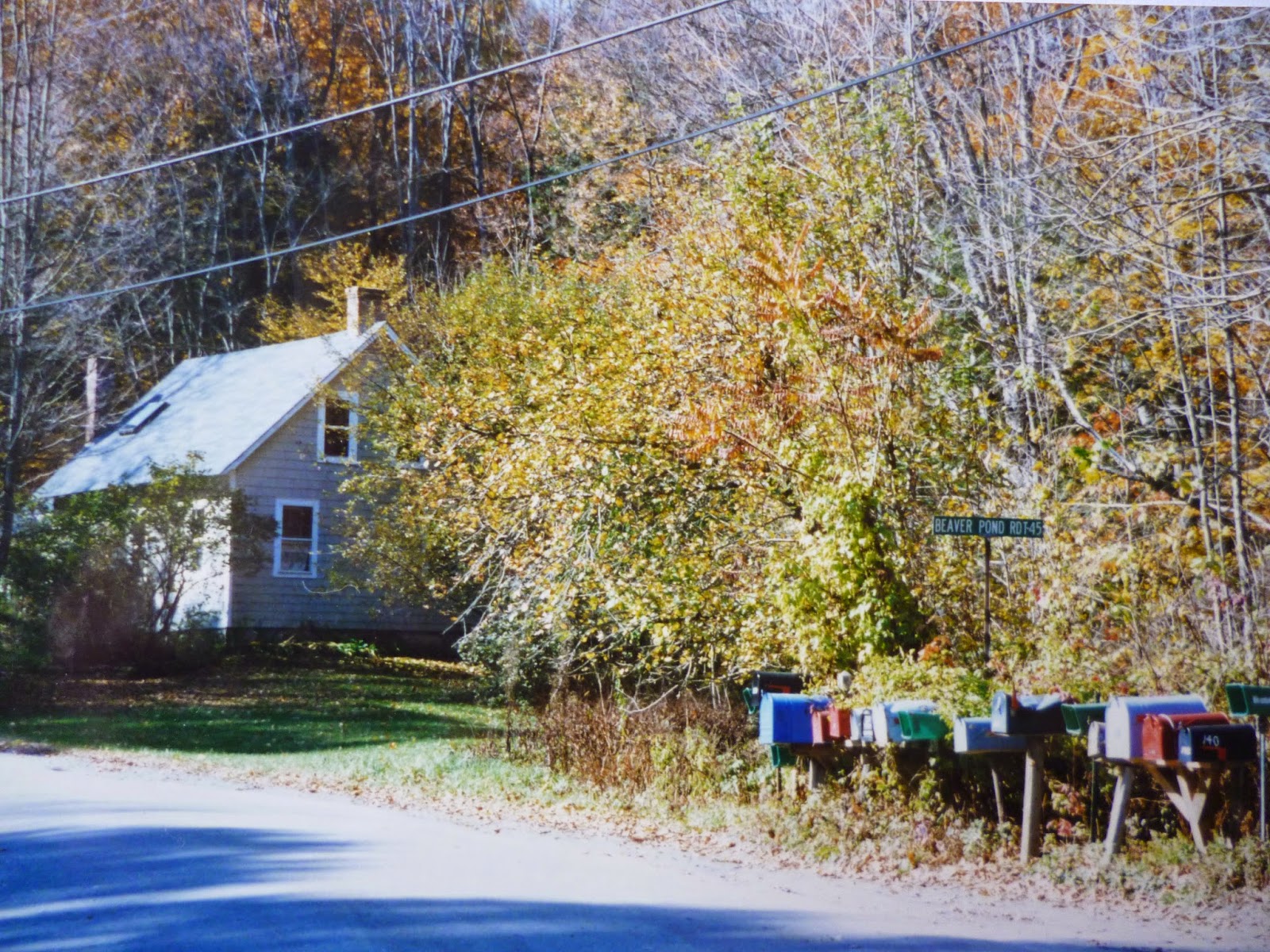
| West Dummerston Mail Boxes |
The above turned out to be a fussy painting but fun. The challenge here was to keep the tree limbs and trunks white (with a bit of shadowing added later). When wanting white when using watercolor, one has three choices. The first and, for me, the preferable one is to use a technique called "negative space" painting ... which means leaving the paper white by avoiding painting those places. You can also use an opaque white paint called gouache which, strictly speaking, is not watercolor. Or you can preserve white areas by painting over those places with a masking fluid which you then rub off afterwards. In fact, I never use gouache or masking fluid. So that left me with the solution of using the negative space technique. At first, I thought of making an extensive drawing in pencil so that I'd know where to leave the unpainted white places and where to paint the leaves. But, I soon decided that was too much work and I'd just "go for it"--a little here, a little there. Possibly too casual an approach, but it seemed to work.
| Summer Mowings |
And the challenge here (above) was to turn what was basically an all-green picture into something interesting. So I decided to use the design element--the curve of the hedge, grasses, mowing lines, tree limbs. And then to use the central tree trunks to draw in the eye and carry it back down again to the mowing lines.
| Dutton Farm Road in November |
| Kipling Road Country Walk |
| Mary's Garden |
| (Blossoming tree on right seems to have gotten cut off ... sorry about all that reflection) |
| Red Barn in Shadow |
So, there it is.
Subscribe to:
Posts (Atom)