Wednesday, October 11, 2017

The Automotive Experience Then and Now


Anyone remember when gas station attendants used to put gas in our tanks, check the tire pressure and fluids, AND wash the windows?  Must have been some other life time.

And then, more recently, every three months, when I had an oil change, they automatically adjusted my tire pressure.  I never had to think about it.  That's when getting an oil change cost something in the low two figures.  But now, my 2015 model car, uses a synthetic oil that only needs changing every 6 months (and costs a bundle) so I now need to adjust the tire pressure myself since I can't expect it to maintain itself for that length of time.  But for some reason, I tend to make it more complicated than need be.  First, I have to be sure to screw off the pressure caps before even starting the process.  Then, I ask myself, does applying air produce a swishing noise ... or does that come when the desired pressure has been applied?  (Once I thought I was all finished when in fact, I'd let air OUT of my tires.  I know because I found a gas station with a real attendant and asked him to check my work.  If it had been a class room project, I would have gotten a failing mark.) Then, another time, I nearly drove off with the four caps still in my pocket.

Then my 2015 car has a little dashboard light that tells me that either my tire pressure is low or I have a flat tire.  (I wish it would distinguish between the two.)  So when that little light comes on, I have to pull over (if there even is a place to pull over), get out, and inspect all the tires to see if one is flat.  If it is, that's a whole different ball game.  Or if it isn't, I need to find a place to try and fill the tires.  It's not that I've gotten lazy.  It's just that I feel less competent about how to do things.

On the other hand, I can remember when radiators had to be filled ... or when they boiled over on a hot day climbing a mountain.  Then you had to wait for them to cool off to refill--that is, if you remembered to bring a container of extra water.  Then cars were standard shift, not automatic ... which made it very difficult to drive someplace like San Francisco.  You'd stop for the light at the top of a hill, only to slip back a bit (hoping you wouldn't bump the car behind you) in order to get started again.  I drove a standard shift for years but now wouldn't have anything but an automatic.


And then (I've mentioned this before), drivers used to have to open their windows and hold their arms out to signal left or right turns.  That seemed simple enough, I thought, but we lived in a warm dry climate so always had our windows open.  That meant, of course, that when we got to where we were going, we had really messy hair.  Then air conditioning came along and windows had to be closed.  And turn indicators took the place of putting your arm out.   It seemed a great innovation.

Here are some photos of a few of our old family cars.  Pre-war, they are.

This belonged to my parents.


Then they bought this Nash sometime in the very early '40s.  It had the "Bed in a Car" feature which converted the back into a sleeping compartment--handy when we took camping trips.


Our Nash.  I think it was a 1941 model, a good car, but it didn't appreciate pulling a 26-foot trailer when we bought one after the war to "take to the road."


This is what road signage could look like then.  We were near California's Anza Borrego State Park


Sunday, September 24, 2017

A Sunday in September on the Connecticut River


From the Northfield Mountain picnic area in northwestern Massachusetts, south to Barton Cove, and then back again, this leisurely 12-mile round trip cruise takes an hour and a half and follows a beautiful part of the Connecticut River including the French King Gorge.  Until recently, the trip was made on the Quinnetukut II, but the brand-new 44-seat Heritage has now replaced it. Beaver, bald eagles, and egrets grace the scene.  Motor boats, kayaks, water skiers, and folks fishing add to the fun.

Getting under way


"And to the starboard .... "


Approaching another boat as we round The Narrows near  Barton Cove


Heading back up-river


Looking out for bald eagles


Here is the handsome French King bridge near Gill, Massachusetts, which, when completed in 1932, was said to be the most beautiful bridge of its kind in the U.S.


It's a 3-span arch erected by the cantilever method.  Its location follows the old Mohawk Trail.


Afternoon light filtering through the trees


The riverboat runs seasonally, Friday to Sunday.  For those wanting more information, go to Heritage Riverboat Cruise or phone 800-859-2960.


Monday, September 4, 2017

Saturday, August 19, 2017

Your Unsaved Changes Will Be Lost


I don't do Facebook, Instagram, or Twitter.  I don't tweet and I don't text.  I don't shop online preferring to support local businesses.  Nor am I into smart phones.  I do have a cell phone which I got about a decade ago.  It makes and receives calls (when I turn it on) so if faced with an emergency and if I have my little book with everyone's phone numbers in it (no, I don't program them into my phone), I don't go into panic mode unless I then find myself in a place with no cell-phone coverage.  Now all those public phones are a thing of the past.  With a dime ... and then a quarter ... and then a calling card .... they came in quite handy.  And you didn't have to make sure you had a pocket or a bag to keep one in.

Then my computer presents problems with such messages as "An error occurred ...."  Or "It will take some moments while we upgrade your ..."  Or the modem is behaving improperly.  Or the wi-fi apparently didn't like the last thunderstorm.  Or the grid is down.  Or the grid isn't down but acts as if it were, so you have to fiddle with things you know nothing about to try and fix some oblique problem.  I admit to liking a computer for writing as opposed to typewriters of old, but then you have to have a separate printer to get any hard copy. (Though hard copy itself may be obsolete one of these days.)   Plus pay more than $100 for an ink cartridge to fit into the printer. You used to get a typing ribbon for a couple of dollars and that would do for all the letters you wrote for a good year or so.  Of course, I realize no one writes letters anymore.

A bunch of hand-written and typed letters from the old days.   Yep, I kept them!! 

Then who besides me finds it harder now to hear people on the other end of the line if those people are on smart phones or cell phones.  I prefer my land-line which gives me a better connection.  More grounded, you might say.  So often, nowadays, it sounds as if the person on the other end is multi-tasking deep in some Mayan well or talking while surfing a kahuna.

Then there's the nuisance-phone-call thing ... like several a day sometimes. About the back brace they say I ordered -- but never did. Or my Microsoft connection which is about to fail. Or some problem with my bank account. Or something else which I don't pay attention to because I've already hung up by then.  One nuisance person called and asked if he could speak to me and I said, "No, you can't."  "Why not?" he asked.  "Because you're a fraud," I said. "I'm not a fraud," he replied, then giggled and hung up.  (I've gotten so I can recognize their voices.)  I used to keep track of nuisance-call numbers so I could report them to the Do Not Call listing, but then I realized the callers kept switching numbers.  They also began using local numbers so you'd think it was some friend.

Then, not long ago, when I was on the phone to one of our Top Computer Companies, I kept getting interference from their Hold Music.  There I was, trying to hear what they were telling me as we worked together to solve a computer problem, all with Johnny Cash on the line, too, as if he were blowing bubbles through a Ring of Fire off in some bog.

"Your call is important to us."
     "Our options have changed."
          "I'm either on another line or out of the office."


Sunday, July 30, 2017

More from My Travel Sketch Book

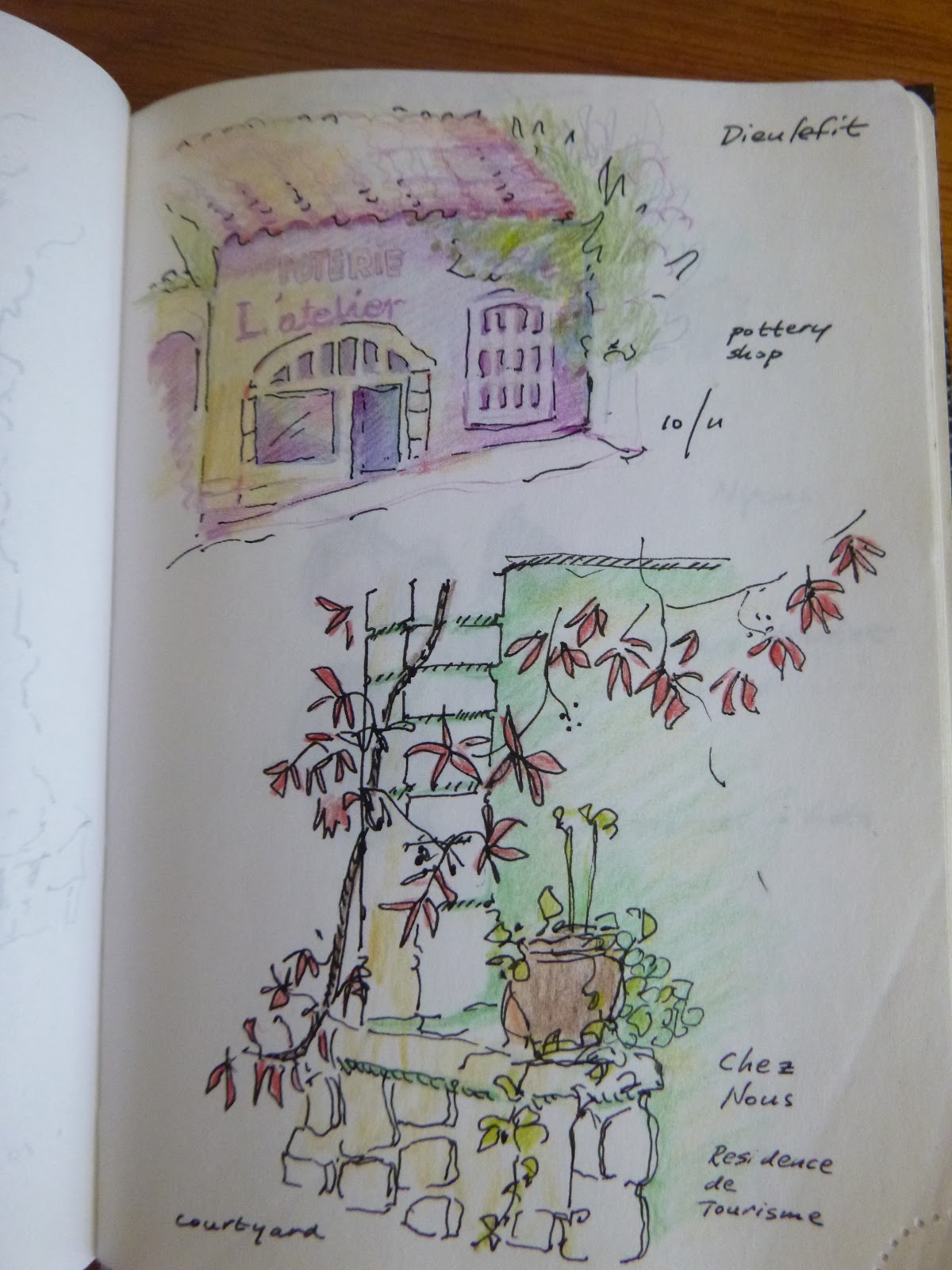
Since it's vacation time, I thought I'd include more pages from my travel sketch book (see my June 16th posting) as further inspiration for you to start a sketch book of your own.

Olive trees and the Alpilles mountains in Provence


Scenes from Dieulefit, France


A Marsden Hartley painting in Boston's Museum of Fine Arts


Looking out over the hills of Ojai, California


Calvin Coolidge's Vermont birthplace


The Indian Ocean from a beach in Bali


Wooden statue of Guanyin at the Honolulu Academy of Arts (great spot, by the way)


A local lake, done to the tune of bull frogs.


Crossing the Canadian Rockies by train


Sunday, July 16, 2017

A Visit to Old Sturbridge Village

The Fenno Barn and pasture


On the Fourth of July, family members and I drove the nearly 90 miles down to the heart of Massachusetts to Old Sturbridge Village, listed as "an 1830's working village and farm with costumed artisans and farmers." With plenty of sunshine and just-right temperatures, it was a perfect day.  A fife and drum ensemble tootled along various byways over the course of the day. A crowd gathered late morning to hear a reading of the Declaration of Independence plus patriotic poetry followed by a naturalization ceremony welcoming new American citizens who had chosen to be sworn in on that particular day and in that particular place.  And at 1:00, militia fired a cannon in celebration of the Fourth.

Our little party, in the meantime, was busy taking a gander at the turkeys plus spring lambs and chicks ... with a peek inside the Fenno House where one woman was carding wool, another twisting it into yarn, and a third wrapping it on a measuring rod.  Though not all shown everyday, OSV demonstrations include dying wool, weaving, blacksmithing, operating the sawmill, making soup over an open fire (and bread in a brick oven), grinding corn, making pots, shoes, and brooms, plus firing that cannon on special occasions.  All great fun.

We also discovered what is called the game of graces (from the French le jeu des graces), an early 19th century lawn game played with small hoops and sticks that young girls enjoyed and that supposedly helped them become graceful.  Basically, it involved tossing and catching a small hoop with the use of two sticks, one in each hand.

Here are some photos of our day.


Spring lambs


Coach ride


Center Meetinghouse


Turkeys
Friends Meetinghouse


Wrapping twisted yarn

Style of the day


Wallpaper in the Towne House


The Towne House dining room


A bedroom in the Towne House


Part of the Towne House kitchen

One of many flyers outside the general store


Tending one of the gardens


Making pea soup (right-hand pot) in the Bixby House


Carding Mill (in front) and Grist Mill


Inside the Carding Mill


Militia getting ready to fire the cannon


Tuesday, July 4, 2017

18th Century Version


I don't know about you, but whenever I run into the term, "Revolutionary War patriot," I waft through a few visions including Mel Gibson yelling, fighting, making a big fuss in the movie, Patriot, which, in fact, I never saw.  (Who needs more bloodshed!)  Or, I envision our F. Fathers in their 18th century attire doing Their Thing to Make Things Right.  Patriots, all.  All, of course, done with fervor, for flag and country.

So, when I came upon a piece from that day requiring every male to take an oath, I realized it had been less fervor and more livelihood.  That or else leave the country, please.  All this came up when I was working on my genealogy bit last year and found several antecedents with a little subscript note to the effect that they had "taken the oath."

That meant, at least in their state of Maryland, that all free males over 18 were required to go to the magistrate of their county by a certain date and take an oath renouncing the king of England and supporting the new revolutionary government.  Or else.  If they didn't, they would have to pay triple their annual taxes on real and personal property.  They would be prohibited from practicing their trade or profession including medicine, pharmacy, law, education, church.  They could not vote or hold any civil or military office.  And then the magistrates had to submit the proper paper work or be fined 500 pounds.   Hmmm ... why did I imagine the whole thing was more voluntary than that?

So one, then, became a patriot or remained a loyalist, royalist, or Tory and skedaddled off to Canada or returned to Albion unless he didn't care about his job or could afford to triple his tax rate.  One family antecedent, finding himself in Boston in 1775, decided things were heating up so got himself north of the border where that branch of the family remains.