Saturday, August 18, 2012

Let's Hear It for Organic Corn!


Disclaimer:  actually, I've been off corn for some time.  That's right:  popcorn, polenta, corn chips, corn bread, corn on the cob, and of course anything with high fructose corn syrup in it.  Which can include crackers, salad dressings, fruit juice, you name it.  I carefully read all the ingredients on anything I buy.  Just put being off corn down to an intolerance of some sort.  But, if I were eating it, I'd only pick something specifically labeled "organic" or I'd buy directly from the farmer since it's impossible to tell which is real corn and which is GMO (genetically modified organism) corn.  (There are no laws in this country regarding GMO labeling.  You can guess who lobbied for that!!  The less we know about what we eat, the more money they'll make.)

One of those same big biotech corporations was apparently instrumental in the recent coup of the democratically-elected president of Paraguay because his government would not allow them to bring in GMO seed, move family farms off the land, and install their agri-business health-destroying product with the insecticide built right in.

Unfortunately, GE (genetically engineered) products result in obesity because the body can't handle them.  This seems a no-brainer to me, but there are now valid studies including one showing that fish, rats, pigs, and mice put on weight they can't take off if fed these products.  As well, their organs are altered, they are permanently less able to digest proteins, and their immune systems change.  All life-altering effects.  All of which affect us if we eat this GE grain or anything fed this grain.

It's also a no-brainer to find that what's happening in Paraguay is happening elsewhere.  GMO seed is being pushed on various countries.  GMO corn is now the largest crop in Hawaii.  (Most pineapples got shuffled off to Central America.)  And even if farmers don't plant GMO seed, we all know that the pollen can drift over to their fields. 

Nor is this GE process only happening to corn.  The list goes on:  soy, canola, wheat, sugar, cantaloupes, etc.  (See link below if you want to read them all, except it gets a bit depressing.)  If the seed companies (who also produce herbicides and pesticides) had their way, they'd achieve a monopoly on all seed everywhere.  Not news, really.

But here's the real McCoy in all its glory at our local farm stand.

And here's the link to the study 


Saturday, August 11, 2012

Connecting at Last Week's Farmers' Market


I'd just published my blog posting last Saturday morning--thinking about who might latch onto it out there in cyperspace--when I then went off to our weekly farmers' market.  As I turned in the parking lot, I spotted a bumper sticker on the car ahead of me that read, "No One Cares About Your Blog."  I have to say, that gave me a good chuckle.  I didn't take it personally.

I adore the farmers' market but admit to not doing much more than an in-and-out these weeks so have not been hitting all my usual vendors with subsequent chit-chat.  After some seventeen years, now, I'm known as a regular (and early-bird) customer and get smiles of recognition.

"I haven't seen you lately," Susan says, as I pick out a head of her garlic.  "Have you been away?"

"I haven't been feeling well," I admit.  "I came down with Lyme this summer."

"No!  Everyone's getting Lyme.  I know more people who've gotten it recently."  In fact, around here, Lyme disease is an epidemic.  I know at least a dozen people, not counting myself, who have it or have had it.  Of course, we have a plethora of deer here that carry the Lyme-infected ticks.  I've also heard that mice carry them ... and that their natural predators (foxes, coyotes) aren't as numerous as before.  And then some say the outbreak of Lyme this season relates to our having had a mild winter.  (So much for mild winters!)

After paying for the garlic and promising to relay a message for Susan, I say goodbye and go on to buy flowers, cucumbers, potatoes, sun-gold tomatoes, and Indian take-out.  It's a sunny morning and, feeling a bit perkier than usual, I make the rounds.  Vendors and I chat.  Jerry, the flower man, calls me by name.  When I inquire about one farmer's lettuce, he tells me, "Next week.  It's been too dry recently."  Another says the same thing.  A third has a basket with only a few heads.  I pick one out.  "It's only 75 cents because it's so small," the farmer tells me.  "I don't have much this week.  It was too wet at planting time."  (Too wet, then too dry, it makes for a week of little lettuce.)

As I'm about to leave the market, I find that Peter, the meat-man, is back--for the first time in a year and a half.  He smiles when he sees me:  I'm a good customer of his grass-fed lamb, his pork and beef.  But it turns out he has no lamb.

"I lost at least twenty sheep to coyotes this summer," he tells me, "including ewes, lambs, and one big ram."  And then the dead ewes' little lambs aren't doing well.  "I had to bring all the sheep down from the pasture, even though I'd put up more than five miles of 'permanent fencing' ... or so it's called.  It was a lot of work putting that fencing up," he adds.  "But after twenty years, brambles get to it.  Wild roses.  Moose ... bear ... deer.  Trees fall on it.  And limbs from all our storms.  I can't go up there and keep mending it." 

He asks after the family, then says he's glad to be back at the market.  "I realized what was important about coming here," he says.  "Meaning and identity!  I had customers come to the farm, but it wasn't the same as meeting them here at the market."

We chat on.  Since there's no lamb, I ask for the smallest packets he has of ground pork and breakfast sausage.  He knows I like small packets (I live alone) and says as he reaches into his cooler, "I thought of you this morning when I was packing these."  As he hands them to me, he returns to his meaning and identity theme.

"It's all about connection," I offer.

"We all need it," he says.  A friend of his, a nicely-dressed man who's been listening in, smiles.

As I'm about to leave, the man shakes my hand and says, "I'm happy to meet you."  He tells me his name--a European name.  Ah, those Europeans, I think to myself, and their charming manners.

"Are you Peter's neighbor?" I ask.

Peter gives a little smile.  "He married my ex-wife.  How's that for a connection!"  As I head toward my car, Peter calls back, "I'm the god-father of his children.  How's that for a connection!"  I smile and wave.

Back home, while boiling up my newly-purchased potatoes, I muse that it would have been infinitely nicer if one of Peter's coyotes had killed the mouse (or deer) that carried the Lyme-infected tick that got me instead of the grass-fed lamb that I would have bought.  I also think about connections--vendor and customer, Peter and his friend, plus blogger and any readers who happen along.  Who they are, where they are, what they've sought ... and if, in reading a blog (such as this), they've made some meaningful connections.


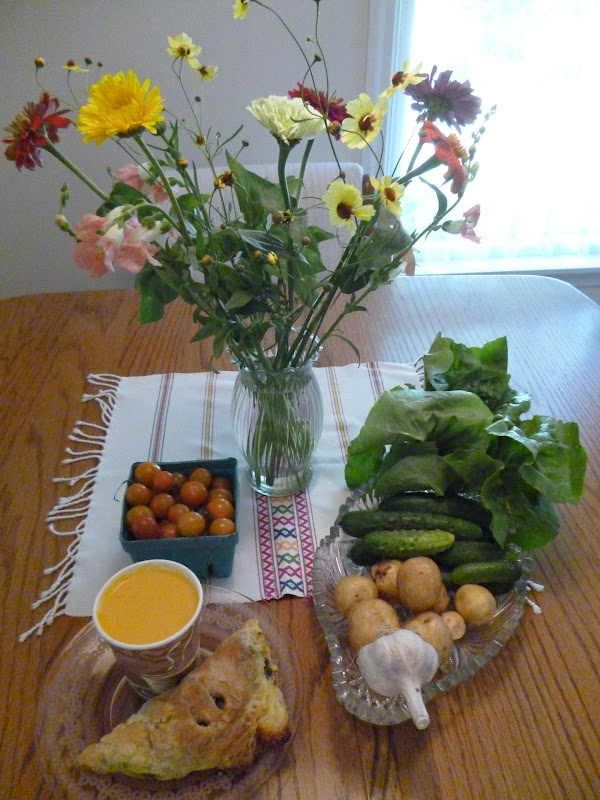
My morning's purchases (except for the meat).  The orange drink is mango lassi, the pastry is an alu palak.


Saturday, August 4, 2012

Oh Where, Oh Where Has the Adverb Gone?


Have you noticed that our dear, sweet lovely adverb that modifies a verb and an adjective and another adverb seems to be getting short shrift these days?  To wit, overheard on the TV:

"He did that perfect."

"My business is doing wonderful."

(From an artist) "I'm laying this sky on pretty heavy."

Okay, so I'm talking about the "ly" adverbs here.  Perfectly.  Wonderfully.  Heavily.  (Not to be confused with "ly" adjectives such as, "He's a friendly lad."  Or non-"ly" adverbs such as "quite," "well," "often," "again.")

If all of these incorrect speakers were creative writers, I might get a hint as to where the adverb has gone since writing classes/workshops/teachers tell their students (and I've been one of those students) that the "ly" adverb can (for the most part) be eliminated because it speaks of amateurish writing--Trying Too Hard To Be Descriptive.  The thinking seems to be:  Why dress up a weak verb with a burdensome adverb when you can sharpen the verb, eliminate the adverb, and keep your writing sprightly?  Why say, "He walked quickly" when you can say, "He dashed"?  That sort of thing.

I even long ago copied out a fine description I read in The New Yorker in a piece by Roger Angell.  "Use the short adjective rather than the expected adverb.  'A soft owl flew over the lane.'"  For a writer, it's excellent advice.

Except how many speakers today are turning "ly" adverbs into misplaced adjectives because they've been in creative writing classes!  Anyway, they'd know better.

Some problems result because the speaker eliminates a few words.  So, as I heard on the Weather Channel, "Life started out normal ... "  Using "normal" here would work if you said, "Life started out to be normal ..."  Then, "normal," an adjective, would define "life."  But as used here, it defines "started" so needs to be "normally."  And when a cooking show's hostess said, "The chocolate angel food cake came out pretty good," she really meant to say that it came out pretty well.  It was good, but it came out well.  It's just that sticky little difference between being an adjective or an adverb.  Between modifying the subject or modifying the verb.

Then there's that sign we see everyday:  "Drive Slow"(ly).

It all comes down to sloppy thinking, sloppy educations, plus a total lack of concern for proper grammar.  So much of what goes on today (at least in this country) seems to lack structure.  Do your own thing.  Who cares if you can't speak the language properly!

Aside from the adverb problem, here are some other transgressions I've come across.

From NPR:  "So much more faster."

A recent book supposedly written in the 19th century vernacular that speaks of "the get-go."

The name of Roy Lichtenstein's 1964 painting, "Ohhhh .... Alright ...." that recently sold at auction for $42.6 million.  (At least the movie, The Kids Are All Right, got it right.  "Altogether" is one word, "already" is one word, but "all right" is two words.)

From a letter:  "I would have went ..."

From reality TV programs:  "If her and I get married ..." and "If it was really tore up ..."

From a news source:  "A dead lion lays by the fence."  There's that lie/lay thing again.  (See my December 10, 2011 posting.)

From Wikipedia:  "the eldest son" of two boys.  ("Eldest" is used if there are three or more; otherwise, you use "elder.")  

Conversely, Diane Rehm often says that she "feels badly" about something.  I was taught that feeling badly means that your sense of touch is impaired.  No:  you feel bad about something.  So, yes, verbs of the senses ("touch," "smell," "feel," "taste," "look") take adjectives.

So how do I illustrate a posting on the adverb?  How about a camel-riding tourist smiling jauntily at the camera!


Saturday, July 28, 2012

Yippee Yupo®


Though I have long used a nice French cold-press paper on which to paint watercolors, I have been frustrated by cold-press's quick absorption, its fading of color.  I'll load on a cadmium red only to find that it's lost its brilliance by the time it dries.  So I've tried smoother, less textured hot-press paper.  I've also tried the technique of applying a layer of acrylic gesso (a polymer medium found in any art supply store) to a sheet of paper, letting that dry, and then painting on that.  I like the slipperiness of the application, the little surprise elements that appear within the painting itself.

Because of the rather mysterious effect this technique produced, I named this "Petunias Out of a Parallel Universe"

But it wasn't until I took a painting workshop one autumn in southeastern France (in the Rhône Alpes region)  that I was introduced to a synthetic paper called Yupo®  made from polypropylene.  So it's not really paper but plastic.  It's also waterproof.  Which brings up the rather intriguing question:  "So you use watercolor to paint on a waterproof paper?  How does that work?"  I'll answer that by saying that it seems similar to skating on ice.  You slip and slide a lot.  Far from being absorbed into the paper, the water pools in odd places, the paint skids across the top.  And, the colors keep their brilliance!  Having much less control over the process, you find yourself with some happy accidents.  And, though I've never painted on porcelain, it seems not dissimilar.

As many watercolorists know, once you apply paint to hot- or cold-press paper, you can't lift it off.  Which means that though you can go back into the area with a clean damp brush and remove a little paint, you can't take off all that much.  It's there to stay.  (Or, at the very least, there's always a palimpsest.)  Which may be one reason people say that painting in watercolor is more difficult than painting in oils.  (Oils allow you to paint over something.)  But Yupo allows you to lift the paint off at any time.  In fact, you can wash the entire painting down the sink and start over on the same sheet.  Lifting a bit of color here and there can be handy when you want to open up an already-painted area--for sky, say, or a highlight.  The beauty of it, then, is that you are not committed to keeping what you have set down.  You can play with it.  (It can take several applications to get the paint to adhere exactly where you want it, but that's part of the fun.)

Here are four examples of my Yupo work--plus the photos I painted them from.
"Afternoon in the Abbey Gardens" (Villeneuve-lès-Avignon, France)


"Blue Bridge" (Dieulefit, France)
Poles, wires, and all
"Le Pègue"  (Le Pègue, France)


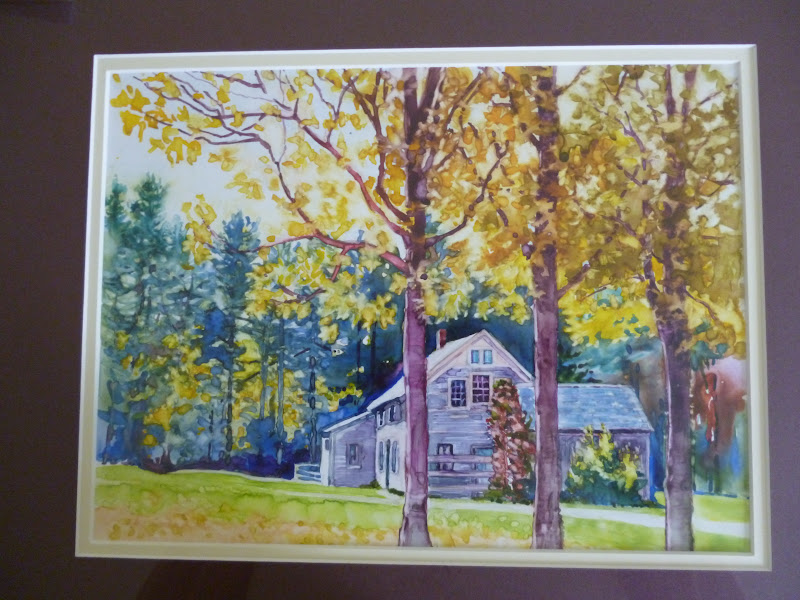
"House on Dickinson Road" (Vermont).  Though one can plan out an entire painting and then apply a masking fluid (to later rub off) to parts that are to remain light, such as the sky between the leaves plus the sunlight down the left-side of the tree trunks, I paint in a less regulated style and so quite dislike the masking technique.  Here, I achieved the same result by simply lifting paint off wherever I wanted.


Saturday, July 21, 2012

"One" Cookies

It's too hot these days to think about much ... certainly not turning on the oven as this recipe requires.  But when the weather moderates, stir these up and see how heavenly they smell while they're baking.  They also go beautifully with a chilled glass of your favorite summer refreshment.

There are times when I like to pore over recipes, note a few that look tempting, and make up an appropriate grocery list.  And ... there are times when I just want to dive in and make something.  For me, making cookies always means hunting out a just-right recipe which can take some time.  So ... I made up a recipe that was easy to remember because it calls for just one of everything.  I call it "One" Cookies.  These are coconut and orange flavored but the recipe lends itself to just about anything.  Cardamom and chopped nuts.  Cinnamon and nutmeg.  Ginger and molasses.  Bits of an organic chocolate bar.

"One" Cookies

Blend 1 stick of (preferably softened) butter with 1 c. brown sugar (hoping it hasn't solidified since you last used it).

Mix in 1 egg.

Add 1 c. flour plus (and here I've cheated a little, but these do add up to 1 teaspoon) ½ t. salt and ½ t. baking soda.  Mix.

Add the zest of 1 medium-size orange plus its juice.  (I like to use an organic orange, especially since I'm using the zest ... which we used to call the grated rind.)

Finally, mix in 1 c. shredded sweetened coconut.

Place in small spoonfuls on a greased or parchment-covered cookie sheet.

Bake 365º for 12-15 minutes.  

Yum.


Saturday, July 14, 2012

La Cité de Carcassonne


One of my very first exposures to France came in the form of a wonderfully thick-paged paper-covered book of black-and-white photos showing the fortified town of Carcassonne in the South of France, not far from the city of Montpellier.  (In fact, the town is divided in two by the Aude River--the fortified part is called the Cité and the lower, "newer" area, the Ville Basse.)  As a child, I would fetch out the book, open it up, and pore over the photographs of this totally intriguing, storybook-like, quite theatrical-looking place.  I believe my grandmother purchased the book when she and her sister went to Europe in 1928, but whether they actually got to Carcassonne, I don't now remember.

The magical views stayed with me over the years so that when I found myself in Montpellier studying French just five years ago and my hostess offered to drive us there, I was thrilled.

Carcassonne was one of those spots that got a lot of traffic over the ages.  It lay on a route linking Iberia to the rest of Europe and began as a pre-Roman settlement.  After the Romans, the Visigoths came.  The Saracens.  The Franks.  Cathars settled there but were then driven out during the Albigensian Crusade when the Catholic Church considered them heretics and even housed their own inquisition in The Inquisition Tower.  By then, Carcassonne was a fortified medieval city with double ramparts to protect against siege engines, the outer wall connecting fourteen towers, the inner twenty-four.

Later, the kingdom of France took it over.  During the Revolution, it became a supply depot.  Then it was turned into a stone quarry, its walls and towers gradually dismantled.  It was even scheduled for demolition until a campaign saved it and a conservation architect Viollet-le-Duc carefully restored it during the second half of the 19th century.  His successor finally finished the work in 1910.  Now Carcassonne is one of UNESCO's World Heritage Sites.  It is also the largest medieval town in Europe with its walls still intact.  Today, approximately 120 people live there permanently ... with maybe 48,000 in the Ville Basse, the unfortified section across the river.

Entrance


The double ramparts

The Basilica Saint-Nazaire inside the walls

Inside the Basilica

I took this photo for the beauty of the construction.  It may be a private house, but I have no idea.  The Cité also has a post office, school, hotel, and an open-air theater.

Place du Chateau square

School Museum

A commercial area near the exit

Posted today in honor of France's Bastille Day.


Saturday, July 7, 2012

A Gallery of Clouds

I live in a beautiful spot literally surrounded by trees.  Great white pines.  Maples.  Eastern oaks.  Squirrels and chipmunks abound as do crows, cardinals, robins.  But, for me, at least, the horizon around here is too enclosed to see sunsets, moonrises, dawns, plus the wide sweep of both landscape and cloudscape.  When clouds do come, they seem to sit on top of us, simply covering the day.  Once, when dining outdoors with friends in Western New York, off there in the Finger Lake Country, I looked up and said (with great enthusiasm), "Look, a sunset!!"

My friends were amused.  "You have sunsets where you live ..."

"No," I replied, "there are too many trees."

I've always liked Looking Up.  Studying the clouds.  When I lived in Santa Fe, I particularly appreciated this time of year since it brought the sweep of thunderstorms as they advanced from west to east.  And the dry air, the high blue skies proffered a variety of beauties. Cumulonimbus, nimbo-stratus, cirrus, strato cumulus.  I had a cloud book as a child and could rattle the names off better then than I can now.

New Mexico

Illinois
North American Plains
An anvil cloud, New Mexico
Colorado

New Mexico

Colorado
Spain