Saturday, July 11, 2015

Cooking for One

Yes, I was one of those who had a large dining room table and came up with dinner party recipes for six, eight, or ten of us.  I had a fine collection of cook books and enjoyed plowing through them for tasty combinations.  (All on an electric stove and no dishwasher.)  Of course, I also fed the family three meals a day for I don't know how many years.  I made sourdough bread, zucchini pickles, yogurt cheese.  We grew our own tomatoes, green beans, lettuces.  Even then (the '70s and '80s) we were concerned with eating as organically and locally as possible.

Then things shifted and I found myself cooking for one.  Over the years, bit by bit, I've gotten rid of most of my cook books.  On yet another downsizing roll, I've now discarded even more.

Here's what's left.


In fact, they no longer fit my life style.  I no longer give dinner parties.  Nor do I know anyone here in my age group who does.  If people do happen to get together, except for Thanksgiving and Christmas, it's potluck or take-out.  (Mostly, we opt for lunch at our favorite Chinese restaurant.)

But cook books have two main flaws for the single cook.  All the recipes serve 4-6 or 8-10 or 10-12.  Not simply one!  Of course, I can cut the recipes in half or in quarter, but then, if it calls for cream, say, I'm using such a small amount, it doesn't pay to buy it and have it go bad in the fridge while I'm thinking what else to do with it.  Or, a recipe calls for 5 egg yolks.  (Which makes a cake I can't possibly eat by myself ... and I don't really know anyone who eats that sort of thing anymore.)  Then there are the egg whites to deal with.

Another example:  I recently re-read Anne Morrow Lindbergh's Gift From the Sea in which she mentions making biscuits.  Ah, biscuits, I thought.  They sound good.  So I got myself a quart of buttermilk and made a good dozen.  But I only needed 2/3 c. of the buttermilk. It never much works to freeze buttermilk ... and I don't like drinking it.  As for the biscuits, I had two for breakfast and put the rest into a container which I suppose will end up in the freezer.  Can you imagine the French (my role models when it comes to food) taking a biscuit out of the freezer and eating it?  They like things to be fresh!  

Then, too, by the time I've adjusted a recipe to my single-status needs, I've left out a lot of ingredients I don't even get because I can't use them up--which means the final product only half-heartedly resembles the original recipe.  So, why even bother using recipes anymore?  Or keeping cook books?  We can always go on-line to hunt something up.

There's also the seasonal issue.  When it's tomato season, I can't remember where that tomato recipe was that I once saw.  Or, later, that acorn squash dish that looked possible. 

What I need is someone to come up with The Single Person's Seasonal Cook Book.  Small amounts.  Listed by season.  Not requiring ingredients that are only sold in prescribed amounts that will just spoil before I can think what to do with them.

As you see in the photo above, I am still keeping my favorite cook books but probably more for sentimental reasons than anything.  I do still enjoy sitting down and paging through them.

Saturday, July 4, 2015

Up, Up, Up and Outta Sight


As a precaution against winter blues, I recently gave some thought to extending my time away this next winter and going off for a few weeks before heading to my spot in Santa Barbara mid-February to the end of March.  (A Minneapolis woman has it before then.)  But in looking on-line, I came up with big sticker shock.  Of course, Key West, which is walkable and colorful (good photos), was totally out.  But so were St. Augustine, San Antonio, Santa Fe, San Clemente, the Caribbean, etc. all with plenty of nice places for $200 and $300 a night.  Even the tiny accommodation I had in Hawaii only four years ago had gone up by a good $1000 a month.  (And a friend said her place there went from $1900 to $2800 a month in just a year's time.)  I always wonder:  how can people pay that!

Where I stayed

And then people seem to justify such high prices by saying, "Well, things keep going up," as if that was news I'd never heard before. I can tell you one thing that doesn't keep going up and that's income.  Mine, yours, most people's.  In looking around, I wanted a place that was warm, sunny, where I didn't need a car (just more expense) and could walk to town for groceries.  Also, a place I could reach by train or plane.  (Since I wouldn't be taking my car.)  Just for the fun of it I started pulling place-names out of an internet hat to see what the world offered.  I didn't try Moldavia or Bulgaria which I figured were cheap, but I did look at Split, Croatia, which I know nothing about but which turned out to have "reasonable" accommodations, meaning under $100 a night.  As did Nicosia, Cyprus, where I stayed once--guest of a friend.  An interesting city, half Greek, half Turkish.

Of course, that would mean paying air fare to Europe (as well as going through that highly unpleasant experience these days of flying) ... plus transportation from here to Logan Airport in Boston.  Only a very few years ago hiring a driver from here to Boston cost something like $150 one way plus gratuity.  Now the price is $320 one way.  Sticker shock!!  I remember one year when I flew across the Atlantic for less than it cost me to get to Logan.

Then (same subject, different example) I recently read that the minimum wage required to rent a two bedroom apartment in this state is $20.68 an hour ... and that 40% of the households in this town do not make that much.  We used to say that one paid a quarter of one's income on housing.  No more, my lads and lassies.  I could easily move to an apartment in town that would take 100% of my income.  (And they call that good housing for seniors?)  (Maybe they figure you won't mind using up all you made by selling your house, but, I ask, what happens when you get to be 83, you've reached the bottom of the pile, and they turf you out?)

Well, as we're gradually bumped out of one market after another, let's acquire a few flexibility skills.  For instance:  it would seem to me that not all these vacation rentals are full all the time.  So rather than being empty, why not fill them by really decreasing the price!  What do you say to that!

Saturday, June 27, 2015

The Four Seasons ... Around Here, Anyway


With the solstice this past week, I got to thinking about the seasons--about when and what they really are ... at least in these parts!

Everything from October 1 to December 31 is Christmas.  All the holiday hoop-la including finding great yucky spider decorations all over the place since people mistakenly think they're appropriate for Hallowe'en.  Having to hear Rudolph the Red-Nosed Reindeer and Winter Wonderland wherever you go.  Figuring out gifts once again (or trying for no-gifts-this-year) and who-goes-where for holiday dinners.  And then sliding down into winter as the sun seems to set around 4:00, especially after the time change.  The garden gets put to bed--the hoses brought in, outdoor faucets drained, garden furniture and flower pots tucked into the garage.  The car gets winterized and its ice-deflecting wipers put on ... and I stick the car's snow shovel and kitty litter in back, not to take them out again until April.  (The litter adds traction if I get stuck.)


January and February is The Brutal Time.  Icy sidewalks that you have to treat with enormous respect.  Blizzards.  Deep penetrating cold.  No making any appointments or lunch dates without the disclaimer "I'm not coming if it's snowing."  (Which it often is.)  The smell of the oil furnace permeating the house.  Seeing that the front walk is cleared for the postman, especially after the town plow comes along filling in what I just shoveled.  Taking drops of flower essences to treat Seasonal Affective Disorder.  The constant thought that I really should live someplace sunny and warm if it was also affordable.


March - May is The Time to Pick Yourself Up Again.  Repair any winter damages.  Get tax stuff organized.  Do spring clean-up in the garden--move downed limbs, rake leaves, sticks, pine cones.  Figure when to do errands so that I can make a left-hand turn into town without encountering the two rush hours plus parents off-loading and loading their school kids.  And, just generally, feel that things are getting a little bit back to normal after that long haul!


June - September is The Happy Time ... which, incidentally, whizzes by. One day it's Memorial Day. Then a week or two later it's Labor Day.  It's also Road and Bridge Construction Time.  And the Noisy Season with the sound of power mowers echoing around town as well as hundreds of motorcycles on their way to (and then from) Motorcycle Week in New Hampshire.  It's the time to actually make viable dates to see friends ... to go to weekly farmers markets and tag sales (also called yard sales) ... to eat fresh strawberries, lettuce, tomatoes ... even sit in a back yard with a glass of wine and chat with friends, neighbors, family.  In other words, it's The Normal Time ... Time to Get Back to Business.  It's also the time for humidity, thunderstorms, and occasional excessive heat when you need to be sure to carry a sweater with you to counter too-cold air conditioning.


Except, sorry to say, there's one drawback to summer which the man who runs the local wine store recently reminded me about.  When it finally arrives, the days immediately start to get shorter as we then slide back down toward winter.  And after working so hard to get here!

Saturday, June 13, 2015

Painting: Both Sides and the Middle

Rice Farm Road in Autumn 

(Note:  My next posting will be in two weeks, June 27th.)


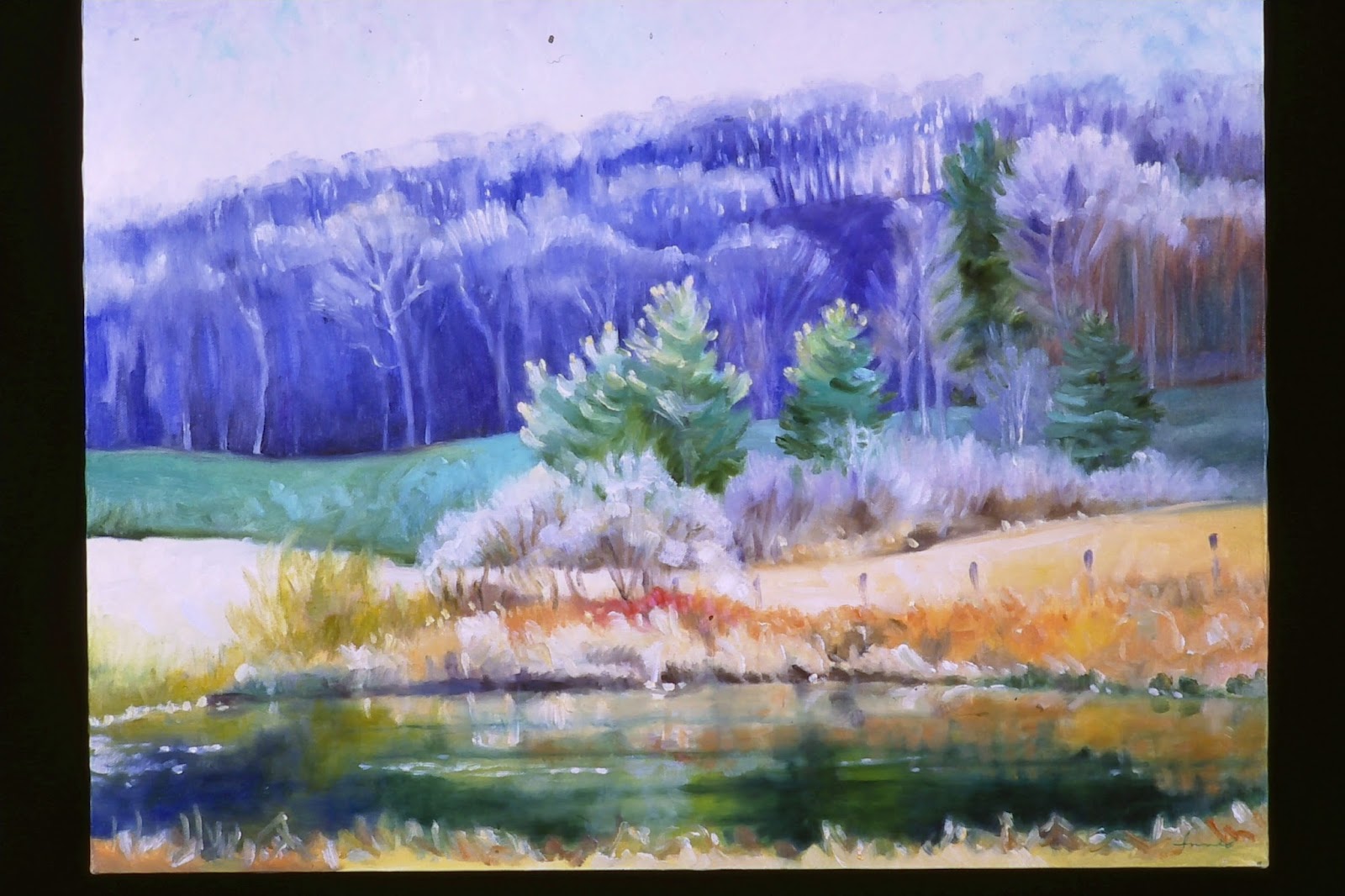
During the years when I was doing a lot of painting, I found myself applying a technique which I will describe briefly ... and offer to any of you who might want to try it.  It's really quite simple ... and, I found, especially good with landscape though certainly not limited to that.

Simply, use different colors (or different shading) on the right and left sides of your painting.  Unless you're really looking for it, you don't even notice it since it can blend in so well, your eye accepts the different colors as a gradation of light.  Then, in the middle, you can also add what I like to call "a jewel"--a warm color or something a bit mysterious to draw the eye in.  (Even a good warm alizarin crimson for shadowing works well.)  Of course, there's also the compositional technique of taking the eye into the center of the work with a road or path.

Peach Orchard 
 Here, the left side has cooler tones than the right ...
with a warm orange "jewel" in the very center.
Last Light
 Yes, the composition puts the green trees in the middle,
but off behind them, I've added another bright orange.

I've posted some of these paintings before, but I include them again to illustrate my point.  Try this out and see what you think.  I've always thought it added just a little more interest, a little more oomph!

(Except for the final painting, a watercolor, these are all oils.)

October Pond
January Hillside
The "jewel" here is the lemon yellow in the sky as well as the deeper rust in the middle foreground trees.  Again, left- and right-hand colors differ.
Blue Trees
 The left/right variable is very apparent here.

Winter Along Kipling Road


West Hill Road 
  The "jewel" here is a lightening of the road's purple foreground shadows into pink shadows in the distance
where the eye then sees an aqua tint behind the far trees.
The left side colors emphasize purple and orange; the right green and yellow.


Saturday, June 6, 2015

Studies


"Harmful to Elderly Hearts"
"Severe Depression"
"Tell Grandpa to leave that glass of wine alone."

Just as we've become Consumers rather than Citizens (in the parlance of the times), doesn't it seem as if we've also become Objects of Study?  Watch out for this; watch out for that. By now, I've got things pretty well figured out for myself and doubt I'm going to be swayed by a study.  After all, wouldn't it be more fun to die after having been on a spree than after having spent years in some nursing facility.  I don't want to go THAT way.  Make it quick and snappy.  After a high on the town ... or rafting down the Colorado.  But don't keep me going because of some study until I'm so frail I can barely move.

And while we're on the subject, what about letting kids enjoy themselves in a park where they can climb trees and drive nails through pieces of wood just for the fun of it.  (As in Tokyo.)  What about not monitoring them quite so much.  I just heard a radio program about children going off to summer camp.  One week at this camp, then home.  Another week at that camp, then home.  When it was better for the child to have four weeks at one camp, do some bonding, and come out with some memorable experiences rather than break the time up so that the parents could hear everything that had been going on and give their approval or disapproval.

It's true, we lived in a nurturing village, but I know when our daughter was growing, my husband once said that we weren't afraid for her because we didn't have television and so didn't have all that fear drummed into us.  We tended to give her a good degree of freedom and let her figure things out.  And the product that we got was truly inspiring ... a joy and treasure of a person, filled with common sense ... someone who is now adventurous and creative.

So my hope is that we can add some fun and humor to our life.  I remember my mother once said she'd rather die than not have butter on her baked potato.  And in France, you see slim, trim women at outdoor cafes digging into ice cream sundaes ... eating with a sense of celebration rather than a sense of guilt.  And then there's that park in Tokyo where children are allowed to take a few risks.  I read about it in a recent book by Amy Fusselman--Savage Park, A Meditation on Play, Space, and Risk for Americans Who Are Nervous, Distracted, and Afraid to Die.  

Saturday, May 30, 2015

Marie Kondo's Magic


I recently bought a book because I liked the title and thought it might offer some good downsizing suggestions.  How to get rid of things more easily ... without taking a long time doing it or feeling bad about tossing something out.  I soon discovered that the book, The Life-Changing Magic of Tidying Up, the Japanese art of decluttering and organizing, was a best seller in Japan and the author, Marie Kondo, an organizational consultant, something of a phenomenon.  I was soon intrigued.


I'm pretty good at keeping things tidied.  I'm also good at going through everything fairly regularly and tossing out.  I call it doing my "room-by-room" thing.  I start in the upstairs corner room, work there until I'm finished, go on to the next room, the next, etc.  Fortunately, I have a place where I can temporarily stash things I no longer want.  When the whole process is over (and this can take days), I then recheck the give-away stash, usually retrieving an item or two.  Then disperse the rest.

But I got some inspiration from Marie Kondo's book, as well.  Her thesis is to take everything that you own, hold it, and see if it produces a spark of joy.  If not, get rid of it.  Don't give it to anyone you know.  Throw it out.  Or give it to a second-hand place.  Start with clothes.  Then do books, papers, miscellaneous items, and finally mementos.  Thank what you get rid of.  Feel the importance of where it was in your life.  Then release that and let it go on its way.

She also advises something my family and I used to do regularly.  We'd say goodbye to the house when leaving and hello when returning.  The house always felt like a great part of our family--and did, even more so, with that little ritual.  As Marie says, think of (and thank) your home for providing you and your belongings with shelter.

There's more, but I'll let you discover her words for yourself.  I found that the book started in a rather sweet, simple fashion and gathered momentum as it went along.

Saturday, May 23, 2015

Bird Tales

Some time ago, an ornithologist on NPR's "The Diane Rehm Show" related a couple of true tales.

The first concerned crows in Japan (those very clever birds) who loved walnuts but couldn't break their shells so dropped them in front of cars waiting at red lights, then fed on them after the cars had run over them.

The ornithologist also spoke of mockingbirds in South Carolina who could still sing the song of a now-extinct bird, exciting bird-lovers who, on hearing it, thought the bird was not extinct after all.

And then there were parrots in some far-off country who were still speaking a few words of now-extinct languages which, of course, was an aid to various linguists.

One of my favorite bird/animal tales found in my reading concerns the Canadian painter, Emily Carr, a friend of the Group of Seven and a great animal lover, who'd once tamed a wild vulture to walk to heel and who gathered various pets about her including a rat (Susie), a monkey (Woo), and a parrot.  As the story goes, once when she was out and the phone rang, Woo opened the parrot's cage, then picked up the phone and handed it to him.

"Hello," the parrot said into the mouthpiece.

"Is Miss Carr there?" the caller asked.

"And who else?" said the parrot.  "Speak up, speak up."

The caller spoke louder and the parrot persisted.  "Speak up, speak up."

I don't know how long this carried on but Woo, the monkey, soon hung up the phone.  It's such a tidy tale, you have to laugh!

This is just one of her books


As an aside, I'd like to recommend Emily Carr's writings in the form of journals, stories, essays, memories--a collection of four books that I found splendid.  She's such a unique and honest individual, it's a pleasure to read her.  Considered Canada's most famous woman painter, she lived from 1871 to 1945, mostly in British Columbia with study in England and France.  She particularly loved painting mystery trees deep in forests.  And subjects related to the indigenous people of the Pacific Northwest, especially Vancouver Island since she spent most of her life in the city of Victoria.

These four books are:

The House of All Sorts
Growing Pains:  An Autobiography
The Heart of a Peacock
Hundreds and Thousands:  The Journals of an Artist.