Monday, May 27, 2019

When Time Finally Caught Up

Picture this:

1.  A cool morning, the river down the hill misty, the air fresh.  As the sun comes up--a beautiful red ball--the gauzy blues and greens of early morning sharpen as brilliant sunlight begins filling the day along with the sounds of birds, bells, and clattering kitchen pans.  Not many miles to the north--the direction of the river's source--distant-blue forested hills rise, giving way to wide stretches of remote upcountry wilderness where the only sounds (or so you imagine) are birds, monkeys, and maybe a wild pig or two. In this place-beyond-time, you find yourself easing into the languid and dusty days, the beauty, the quietude, the simplicity.

2.  You have been here a good week now, staying with the staff in a bungalow on the outskirts of what is little more than a village in this land of red earth and banana trees.  By afternoon, as the heat builds, sleepy dogs lie on the grass, yawning.  Roosters and pigs wander.  A green parrot chatters in its cage. Occasional jeeps scutter back and forth along the town's dirt roads. Down the hill, open-air shops sell cigarettes, soap, cans of condensed milk.  Belled pack ponies make their way through town as radio music filters throughout the neighborhood.  People wait beside the river for the ferry to take them to the small town on the opposite bank.  


3.  Other than that same small town on the opposite bank where you can buy textiles, wood carvings, embroidered shoulder bags, the next place of any size is maybe two days by boat.  But as you continue your work, your stay, you find occasional visitors appearing at the door.  From New Zealand, France, Australia, the U.S.  An anthropologist.  Someone gathering research for a doctorate.  A Defense Department official.  Each seems a bit dazed, as if they've just stepped into some far outpost.  You invite them in for iced tea and introduce them to the man in charge--a doctor from the Dominican Republic.  For this is part of a small hospital compound, the hospital being a 14-bed bungalow raised on cement blocks with a corrugated tin roof.

4.  So where are you?  Where is this timeless back-of-beyond spot?  It's in The Land of a Million Elephants--Laos:  the far northwestern corner, across the river from the town of Chiang Khong, Thailand, in what is known as The Golden Triangle.  Somewhere not that far away, opium is being processed and heroin refined, then transported by those pack ponies with their tinkling bells.  The river, of course, is the Mekong.

5.  Rather than 2019, however, and despite its remote quiet sense, this particular scene is set in the mid-'60s, in the middle of what has come to be called the Secret War when the CIA was working to push back the Communist Pathet Lao. Though it served the local people, the hospital also tended wounded Lao soldiers working with the CIA--brought in by unmarked U.S. helicopters.  The paradox, of course, lay in the fact that while maintaining that certain sense of peacefulness, the country was infiltrated with fighting.

6.  Okay.  Now picture this.  Remember looking north to those remote blue hills and the timelessness that seemed embodied there?  Those were the hills of Burma in hidden land filled with forests, wild orchids, and occasional CIA irregulars making forays into China.  That Burmese borderland, reached only by river boat, lay barely 28 miles from the little Lao town I've been describing--Ban Houei Sai.  Now, take that same borderland and put there instead a $500 million casino recently (in today's terms) built by the Chinese on Lao land given over to the Chinese where (mostly) Chinese tourists come to play. Here is their new playground with green domes and a tall gold-painted crown rising above what was once a canopy of jungly trees. Here are replicas of Greek and Roman statues and Michelangelo reproductions, enormous gambling rooms, a golf course, limousines galore.  With this being just one casino of what may be many to come in this Land of a Million Elephants.

7.  The country has gone from one extreme to another--from opium processing to garish tourism.  Tourism and kitsch are now king.  (And largely Chinese tourism it seems.)  A road now connects the casino those 28 miles to Houei Sai where a brand new bridge has replaced the ferry service to Thailand.  What time had left behind, it has now caught up with.

Ban Houei Sai (now Houay Xai) on the Mekong, Laos, 1966


N.B.  I had not planned on getting involved in a war, secret or not, but was newly employed by the NGO that supported this hospital, and I was soon sent off to the task I was originally hired for:  to work in Nepal.


I'd like to acknowledge the BBC's "The Mekong River with Sue Perkins" program for its Laos update.


Thursday, May 9, 2019

A Gallery of Photos: Spring Scenes


We are in those glorious few days when spring has finally announced its arrival as each and every bare tree turns a pale leafy green.  When out walking recently in a part of town that skirts the Connecticut River, I joyfully took in that new green along with near-at-hand pinks, whites, and yellows. Looking across the river to New Hampshire's Mt. Wantastiquet, I stopped and studied what seemed a million trees looking as soft as cotton.


Happy Spring!


Friday, April 26, 2019

Gallery of Photos: More on the Santa Fe Art Scene


I'm always taken with the art I find in Santa Fe.  For one thing it seems accessible.  Nicely representational. And regional.  (And since I am enamored of the Southwest, that appeals to me.)
Here are some photos I took during my last trip--February 2018.  The first batch is from the Nedra Matteuci Gallery on Paseo de Peralta. It's in a lovely adobe house with gardens and a large collection of Western and Southwestern art including silver, coral, and beaded jewelry, plus paintings by Hurd, Cassidy, Fechin, Higgins, and O'Keeffe among others many of whom were members of the Taos art colony.  Along with the toad (below), the gallery's gardens feature a wide assortment of sculpture.


"Le Toad" by Dan Ostermiller


Decorated kiva fireplace inside the gallery

On cold days, the gallery's fireplaces can be found to be burning beautifully scented cedar logs.


"San Geronimo--1820 Taos" by Catherine Maziere (sterling silver)


One of two interior doors covered with "milagro" ("miracle") charms


The other, just opposite


Another kiva fireplace


And the following photos are from the New Mexico Museum of Art on West Palace Avenue.


"Cui Bono?" by Gerald Cassidy, ca. 1921


One in a series of interior courtyard paintings by Will Shuster


"View of Santa Fe Plaza in the 1850's" by Gerald Cassidy, ca. 1930


Varqueño and chair by Verne Lucero, ca. 2007


And the following painting depicts the burning of 50-foot-high Old Man Gloom, also called Zozobra, the Spanish word for "anxiety."  This event kicks off the Santa Fe Fiesta each year.  It dates from 1924 when Santa Fe artist and marionette maker, Gustave Baumann, constructed the first Zozobra and, along with his friend, Will Shuster, burned it during that year's fiesta.


"Viva la Fiesta (Zozobra)" by Luis Tapia, 1996

An added note about Gustave Baumann.

Baumann was a world-class multi-color-wood-cut printmaker.  Pomegranate puts out a beautiful annual calendar of his work called "A Small Untroubled World" with woodcut reproductions including scenes of New Mexico, the Grand Canyon, California, and Maine.  I get one of these calendars each year--with a different scene for each month--and never tire of looking at the serene landscapes.

Look him up; he did amazing work.


Wednesday, April 10, 2019

More on Santa Fe

Art Gallery, Canyon Road, Santa Fe, New Mexico


Let it be said:  this New England where I live is one of the most beautiful parts of an already beautiful country.  Think May when it is a rich vibrant green with long gorgeous vistas and flowering trees to perk up any soul ... and then October with its stunning colors that vibrate across the land.  But then there are too many gloomy days the rest of the year, too much cold, sleet, ice, freezing rain, or heat and humidity for me to put an A+ on its report card.  An A+ for May and October but the rest of the year, you'll have to judge for yourself.

Spring time


Residence along Camino del Monte Sol


New Mexico has its "lesser" times of year, too, but it tends to be sunnier, dryer, better temperatures (both summer and winter), less gloomy, all of which attracts me and makes me want to return for longer periods.  So, why do I keep returning to New Mexico?  (Though I missed going this past winter.)

Okay, here goes:

It has pizzazz
Sunshine
An interesting altitude (7,000 feet)
A dry, non-humid climate
Gorgeous landscapes
High mountains
Wide vistas
Sunsets to die for
A fabulous combination of three cultures:  Native American,
     Spanish, Anglo (as everyone else is called)
Innovative art
Kiva fireplaces
Fabulous restaurants, great diversity of food
A highly interesting architecture, much of it pueblo style
Thunderstorms in the summer
Sunshine in the winter (with snow on the mountains)  (most years)
Color everywhere you look
The magical incense-like aroma of  local piñon pine and cedar
     burning in fireplaces
People in silver belts and cowboy boots
Bathrooms, kitchens, stairways designed with tiles from Mexico
A Japanese style spa called 10,000 Waves
A climate that is neither too hot nor too cold
A climate that does justice to all four seasons
A place that inspired Georgia O'Keeffe
A place that feels as if you are in a totally different country
Pink and orange earth colors, blue blue skies


One of the town's favorite restaurants


On up Hyde Park Road


Same scene a few months later


Conversely:

The altitude of 7,000 feet can make having more than one margarita totally
     unwise ... and necessary to catch your breath if going upstairs
Juniper pollen season (early spring) can do a number on you
The skies are rarely the blue blue of old but often have a whitened haze
     over them, as most geoengineered skies nowadays
The chile, whether red or green (and, yes, they spell it that way), can be a bit
     spicy and is now found in more and more dishes
Escalating costs have made it necessary for several of my favorite shops and
     eateries to move to a less charming part of town or go out of business
There seems to be a tax on everything including massage treatments.  Once
     some years back when I went to a lecture, it had a tax on it, too

**

I first saw New Mexico, northern New Mexico, when I was seven and my family and I took a camping trip there just after the war ended.  My father, an Easterner, had driven through around 1921 on his way west in his old "flivver" (as he called it) and had fallen in love with the place.  So when gasoline became available after the war, when we no longer needed coupons to buy it, we headed out for the Land of Enchantment. Once in all that melange of childhood, my parents considered moving there.  But we stayed in Southern California, instead.  Another lovely part of the world in that less crowded day.

Typical scene of hollyhocks and blue windows


Randall Davey House


On up the road, by Ghost Ranch


Next time:  More on the Santa Fe Art Scene


Tuesday, March 19, 2019

"Thaw"


This happens to be the exact time of year when I look up a favorite poem of mine entitled "Thaw" by the English poet, Edward Thomas (1878-1917).  Since I cannot determine whether the poem is in the public domain, I will not write it out but will, at the bottom, post a link so that you can call it up.  It is four lines only and lovely in its simplicity and ease in telling a little story that so well illustrates this particular seasonal moment.  To paraphrase the poem:  a thaw covers the countryside as the birds in the trees overhead can see what we on the ground do not yet see--the passing of winter.  Stirring words for those of us who shut down in early November when the time and light change, only to revive when the time and light change again and we ease into spring finding ourselves stepping out without coat, mitts, boots.  Opening an outside door for a moment of sweet fresh air.  Catching the sun's new angle as it now floods the room.

Yes, winter is over.  That doesn't mean we won't get more snow, but the chances are good it won't amount to much.  In fact, I always leave my snow shovel out until April 15th.  But in the meantime, the snow-pack will melt and crocuses will appear.

In looking up more about Edward Thomas, I found that he and Robert Frost were great friends, living for a time near each other during the Frosts' stay in England.  They were such good friends, in fact, that Frost managed to persuade Thomas, a writer, to try writing poetry.  Frost also put the idea in Thomas's bonnet to take his wife and children and go live in New England where they could be neighbors once again and encourage each other as poets, neither of whom was having all that much success just then.

Frost and Thomas also took frequent walks together with Thomas often trying to decide which path to take when they came to a fork, wanting to show his good friend something he thought was in one direction but that turned out not to be.  It seems they even joked about it so that when Frost returned to New Hampshire, he sent his friend a copy of his new work, "The Road Not Taken," intending it to be light amusement.

But Thomas was at a grave cross-roads.  The Great War had begun and though he was a family man and of an age when he need not go, he was trying to decide whether to enlist or not.  (Or maybe move to New Hampshire.)  He didn't really want to go to war, but he did want to meet full-on a depression and what he considered to be a lack of courage that had haunted him for some time.  Reading Frost's poem turned out to be one more kick that contributed to his decision to enlist.  He was killed in action after only two months in France.  He was thirty-nine.

Edward Thomas is one of sixteen Great War poets listed on a memorial in Poet's Corner of Westminster Abbey.


Link to "Thaw"


Monday, March 11, 2019

The Clucking of Hens


My brother and I didn't grow up with television.  (No, that isn't a picture of my brother.)  For one thing no one HAD television then.  It only came in when I was around ten.  For another, we couldn't afford it.  Besides, we were used to our routine, our life-style, and though we found TV to be a distraction, we didn't feel we needed to be distracted.  We preferred doing crafts on the kitchen table or reading some of the childhood classics like Robert Louis Stevenson or going out on bike rides around the neighborhood or helping our mother make cake or ice cream or visiting cousins and playing games.

So now when I turn on TV, I too often feel sorry for children who have to watch programs made for them. Who have no introduction to other things to do in life than sit glued (good word) to the TV since it CAN mesmerize one. But the noise it provides can be rather disruptive.  To my mind, children do not need the constant ups and downs of loud noise even from what are known as "the educational programs"-- what (to my ear) can come across as yelling. All supposedly in good fun, mind you.  They need time for gentle sounds.  The clucking of hens.  The telling of a good story.  The sound of spring rain.  The hum of the car's motor on the way to the beach.  If a child is being baby-sat by being placed in front of the TV, something less frenetic than the children's programs I happen on could be advisable.  Even turning off the volume.

Call me unrealistic.

Or, what about this:  find a CD of hens clucking and play that.  Wouldn't that be soothing!

Friday, February 22, 2019

Cat Happiness

Poppy at Pickity Place, New Hampshire


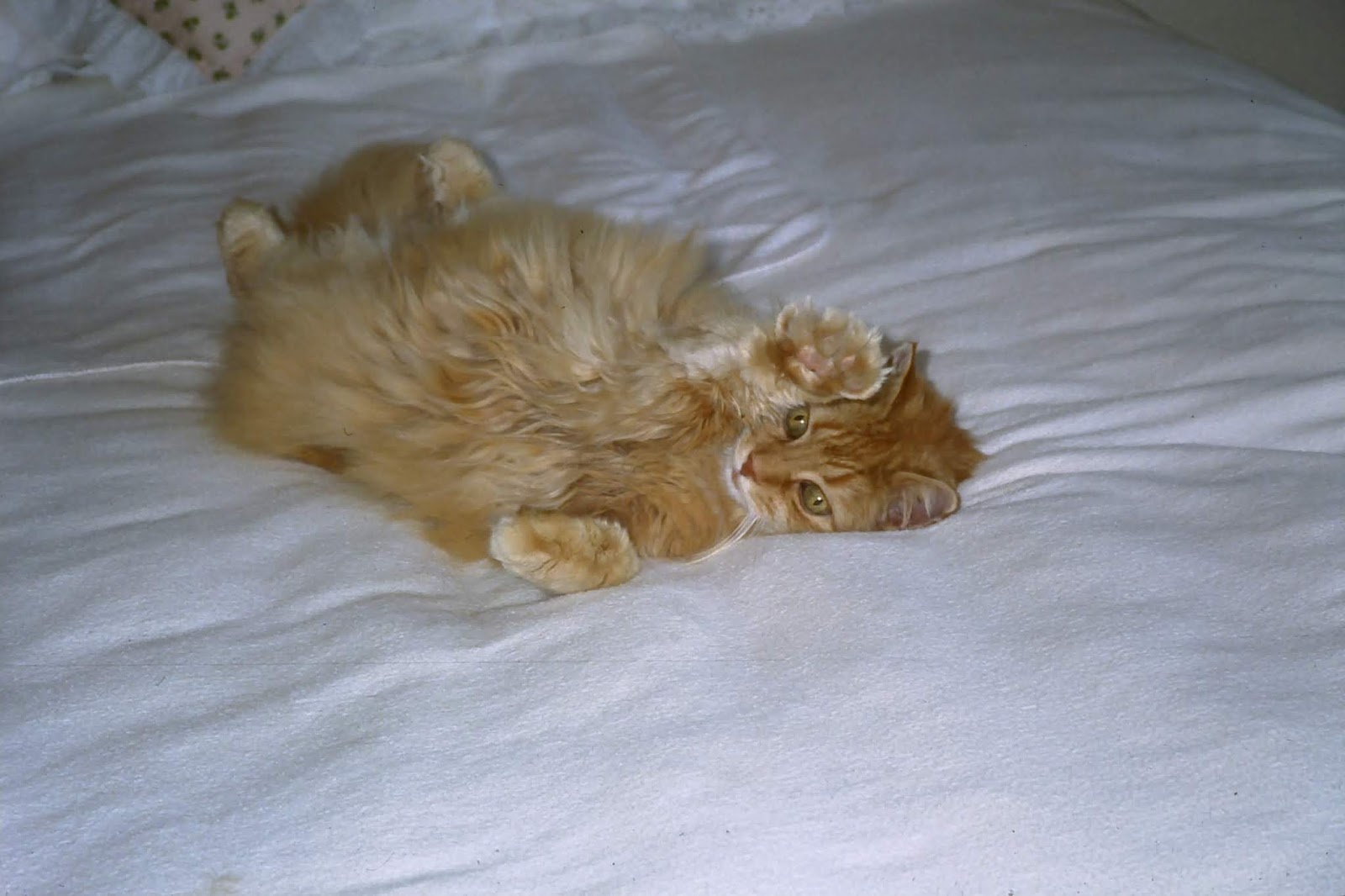
I'm a cat lover though I haven't had a cat in many years.  But I go all soft and gooey when I see a puss  wrapped up in sleep or simply sitting, taking in the world around it.  I prefer Maine Coon cats with their medium-long fur, fluffy tails, and sweet faces.

Just for the record, I like dogs, too, but think they need to be out on a farm where they can roam.  My favorite?  Collies.

Lily (Poppy's sister) also at Pickity Place


A cat in France


Dinah, a family pet


Dinah


Baxter (another family pet) taking a summer snooze


In days gone by