Saturday, June 15, 2013

Mom Nature and the Founding Dads

Am I right or haven't those good words, "mother" and "father," been shunted aside by a folksy rendering of  "mom" and "dad"--unless it's something literary?  I mean, at least we don't speak of Gertrude as being Hamlet's mom or Jocasta as being Oedipus's.  And we fortunately don't refer to Dad Time.  Or the mom in the bottom of a bottle of apple cider vinegar.

I grew up thinking it was only children who spoke of their parents as moms and dads.  As in, "What are we having for supper tonight, Mom." It seemed a personal form of address rather like calling one's daughter, Sweetie Pie.  So that, referring to girls in general today, we might now say, "The sweetie pies will gather at Susie's before the ball game."

I'm not sure what my beef is except possibly our constancy in making things lite or liter whether in language, dress, manners, ambitions, expectations.  Might Lincoln have ended the Gettysburg Address by saying, " ... and that government of the folks, by the folks, and for the folks ..."?  Or today he might have slipped in "you guys" instead.

I was once lunching with some older (my age) friends from Wales who'd just arrived in the States.  As we perused the menu, the waitress returned and asked, "So do you guys know what you want?"  I saw my friends sit up just a bit ... but they smiled and gave their orders graciously.

However, the waitress was no sooner out of sight than one of them asked me,  "What is this 'guys' thing?  Is that like 'Guys and Dolls'?"  He was quite good humored about it but did seem curious.

But, hey, I can go along with all this ... and I'll even pass along a useful little tip.  (And here's the editor in me.)  For anyone writing, remember not to capitalize "mom" or "dad" in the middle of a sentence unless you're using them as you would a name.  "Hey, Dad, a fox just crossed the road!"  Otherwise, "The moms are taking yoga every Thursday morning."

Speaking of it, Happy Father's Day.

A dad ... who happened to be mine though we called him Pop.


Saturday, June 8, 2013

Empty Spaces

Ah, how lightened I felt after November's presidential election to be free of all that hype and campaigning.  But then, immediately post-election, I started hearing talk about the 2016 election.  We weren't allowed any empty space.  Just as, if one went out in the evening in early November, one already saw Christmas lights.  No waiting around, even, until after Thanksgiving.  We used to make it a practice to not play Christmas music--and that included such wonders as Bach's Christmas Oratorio--until after Thanksgiving dinner.  The whole Winter Wonderland complement had been piping through stores at that point for what seemed weeks, and we were of the opinion that less was more.   (Wish our election process felt the same way.)

Then, after reading about the upcoming new addition to the British royal family, I saw a piece, "What Will They Name the Baby?"  Why not, And Who Will the Baby Then Marry When He or She Grows Up?  And who will their heir then be?

There's the noise thing, as well, when something labeled "music" serves as a backdrop whether we're out by the gas pumps filling up or waiting in a doctor's office.  Let's leave some empty space there, too--called good old silence.

And now our skies are getting it.  When I was back in Santa Fe for a few weeks this winter, the formerly bright blue skies were being filled with pollutants on a regular basis.  Some excuse this by saying these are simply the normal exhaust trails from commercial jets called condensation trails.  But con trails are short-lived ice crystals that quickly evaporate.  These are more like an aerosol chemical soup.  It's apparently happening all over but easier to see in the West where the sky seems endless.  Not stuff I particularly want floating down on me ... or on the crops I eat.  I don't consider this blog to be the place for a discussion of the why's and wherefore's--if you're curious, look it up on line--but here are some photos I took.
Looking west one morning around 9 a.m.


Looking east from the same spot

What the sky then looked like a few hours later

Next morning, same place, same hour ... what the skies SHOULD look it!  (If those had been commercial flights, wouldn't they reappear each morning?)


Saturday, June 1, 2013

Wabi-Sabi As I Understand It

Old tree ... irregular

I have been interested in the concept of wabi-sabi since a friend introduced me to it some twenty years ago.  Basically, it is a Japanese aesthetic that embraces the modest, the imperfect, the irregular, the evolving/devolving.  I like it because it recognizes what I might call an un-Madison Avenue, un-Hollywood beauty.  Something with a more spiritual approach, recognizing a humanity, even, within the subject, whether that is an old gnarled tree or a misfired clay pot that no one pays all that much attention to.

One thing I've decided is that wabi-sabi is pretty much the opposite of what we in the West think of as beauty, ours being based on the Greek ideal of perfection.  The young beautiful girl, the perfect piece of hand-blown glass.  Not the woman d'un certain âge ... or something with a highly polished sheen from eons of use. 

In the advertising mode, we are faced with images that are meant to knock our socks off, to make one's jaw drop.  But how often can we keep that up?  So we disconnect.  We drop out.  We decide we want something calmer.  No drama queens, please.  Not even those who pretend not to be.  Here's the weather, they say.  Look at (and celebrate the anniversary of) the disasters that have hit these particular places.  Here's the news.  See what awful things are being done here and here and here.  Here's a program where a couple is looking for a house.  Watch how she wants something in the city and he something in the country.  Oh, conflict, conflict.  Who will give way?

And then our national aesthetic focuses on the bright, the glitzy, the honored, the one that calls out, "I am best" or even, "You are best."  So, to look at the very opposite (and something that does not speak of glorification) can seem downright subversive.  But what a treasure one can find in quietly invisible places, in places that are, that do not shout out to be recognized.

Wabi-sabi, then, is the beauty--even the spiritual path--found in that which is humble, incomplete, rustic, unsophisticated, overlooked, simple.  In a farmers market, it might well be the basket of "Seconds."  The tomatoes that didn't make the expensive cut.

Ferns ... devolving
What I'm wondering is:  as we (as a nation, as people) mature, as we are possibly faced with more austerity in our lives, will we find ourselves tapping more and more into something related to wabi-sabi?  We've so long learned that beauty is perfection that we automatically negate this whole different approach.  Where is the excitement in the modest? we ask  But we can turn that around to ask, what is there within the modest, the imperfect that we never noticed before?  I do believe we're ready for this more internal view, this totally different outlook than the one that's been drummed into us.

Apple orchard farm stand ... rustic
The best book I've found on the subject is Leonard Koren's Wabi-Sabi for Artists, Designers, Poets & Philosophers (Stone Bridge Press).  In it, he shows photos of a leaf decomposing on the ground, the intersection of two mud-straw walls in a typical Japanese room, a trail of rust made by a nail in a piece of wood.  According to him, one of wabi-sabi's metaphysical tenets is that all is evolving or devolving from or to nothingness.  "And nothingness itself--instead of being empty space, as in the West--is alive with possibility.  In metaphysical terms, wabi-sabi suggests that the universe is in constant motion toward or away from potential."  (p. 45) 

Shadows on a wall ... impermanent

Aging leaves on top of a stone wall ... modest, rough

Saturday, May 25, 2013

Sketches of a Gentle Art

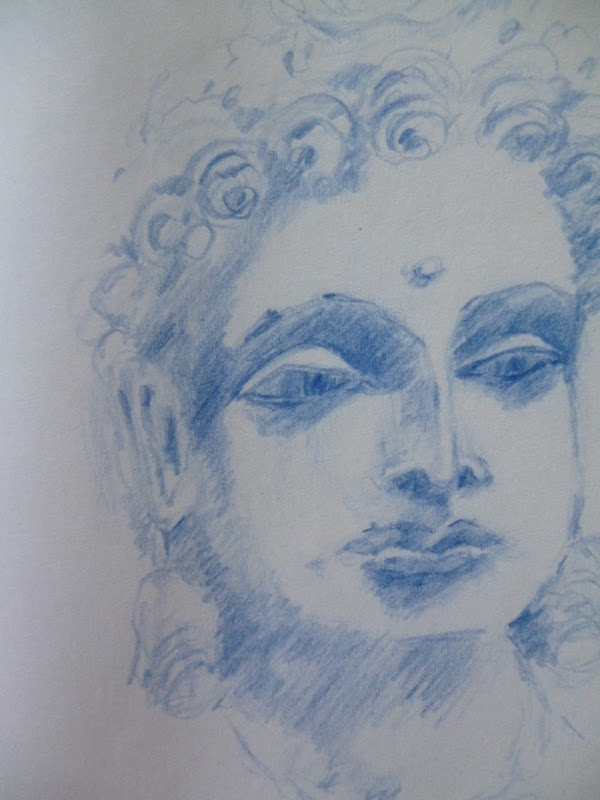
Head of a Bodhisattva, 5th c., Arthur M. Sackler Museum, Cambridge, Massachusetts.

Continuing the mention of South Asia (see last week), I want to introduce you to some of the art from the Gandharan region of Pakistan dating from when it was Buddhist, before the advent of Islam.  Gandhara was an ancient kingdom in what is modern-day northwestern Pakistan and parts of eastern Afghanistan.  Yes, a hot spot today but one to which I feel an especial affinity ... even a long-seated familiarity though I only passed through it once back in 1970 when my husband and I were on our way overland to India.  I valued its high dry landscape, deep blue skies, lamb kebabs, sun-warmed apricots, and men playing stringed instruments.  And now that I am familiar with the Buddhist art that came out of that region, I value it as well--its early representations of the Buddha, bodhisattvas, as well as ordinary men, women, and children.

I won't go into the history except to say that as well as being a center of learning, this was the collection point for such goods as lapis, turquoise, and silk from three major trade routes that came together--from Persia, Central Asia, and India.  Darius added this region to his Persian Empire.  Alexander added it to his.  (He is said to have feasted on 3,000 oxen and 10,000 sheep when he crossed the nearby Indus River.)  Bactrian Greeks later took over.  Then Kushan kings who gave this region its golden era centered in what are today the two Pakistani cities of Peshawar and Taxila.

The art got started by a Kushan king who read Buddhist scripture daily.  (He even wrote a history of Buddha.)  Already acquainted with the West from trade and diplomatic connections, he hired Greco-Roman sculptors to decorate stupas and monasteries with Buddhist art as well as to produce small pieces with which to embellish niches.  These were made from stone, stucco, terracotta, lime plaster--some still with traces of pigment.

This all peaked from the first to the fifth centuries, all with those Greco-Roman elements--Buddha wearing classical Roman drapery, Buddha's mother resembling an Athenian matron, Buddha with an open, Apollo-like face, plus such Roman-style embellishments as vines, scrolls, and garland-bearing cherubs.  Then it all shut down when the Huns invaded after their grasslands dried up and the Great Wall of China stopped them from going in that direction ... and when the Muslim conquest then arrived.

Future Buddha Maitreya as a Bodhisattva, 3rd c., Norton Simon Museum, Pasadena.


Though my husband and I traveled through that region in 1970, we were not then familiar with Gandharan art.  From Afghanistan, we stopped in Peshawar only long enough to change money and get the Khyber Mail train onward.  We passed through Taxila at night, mindful only of reaching India after two months on the road.

Head of a Female Figure, 4th c., The Metropolitan Museum of Art, New York City.  (Terracotta.)

But now I stop whenever I'm near a museum that displays this gentle art.  And sometimes I make a sketch (such as these) because I find the sculptures highly appealing, highly accessible with a lovely human quality, even a sweetness.  I am no scholar of Gandharan art ... but you could call me a hobbyist.

Head of a Youthful Male, 4th- 5th c., The Metropolitan Museum of Art, New York City.   (Terracotta with traces of ocher and red pigment still visible.)

Head of Buddha, 4th to 5th c., Victoria and Albert Museum, London.   (With traces of pigment.)
Standing:  a Bodhisattva, 2nd to 3rd c., Art Institute of Chicago.


Saturday, May 18, 2013

Householder into the Woods

Alpenglow on the Himalayas

I have sometimes thought of leaving this country for good (or more or less for good) whether in protest over one thing or another or (more likely) in search of a gentler environment.  I know that one cannot "go back again," but some places do stick in my mind and Darjeeling, India, is one of them.  Kashmir is another, though since being there in 1980, the politics have totally shifted and aren't good for the likes of me.  At any rate, I fantasize sometimes about what it would be like to put aside most of my worldly goods and enter something similar to the fourth stage of a Hindu's life--the householder who says goodbye and goes off to meditate or cogitate.  (The four stages are student, householder, retired, ascetic/meditator.) 

In this return to a simpler life, I have envisioned a trim, wooden house, perhaps no more than one room overlooking some part of the Himalaya.  It is a fantasy, as I say, but, while immersed in this dreamy state some years ago--twelve to be exact--I sat down and made a quick list of things that came to mind, that I would include in a goodbye letter.  For what it's worth, here it is.


Dear Friends,
  1. I shall write letters, but I shall not expect answers in return unless you are so moved.
  2. I shall think of you fondly at times of celebration, birthdays, Christmas, but I shall no longer necessarily send cards or gifts.
  3. I shall welcome all visitors and will locate accommodations for you when you visit.
  4. I shall devote my hours to reading, painting, writing, walking, dancing, playing musical instruments, drinking cups of tea with friends, arranging flowers in a vase.
  5. I shall get up with the sun, enjoy sunsets across the mountains, and go to bed when it is time to blow out the candle.
  6. I shall strive to live as healthy a life as I can.
  7. I shall hope to live where I can walk in one direction into fields and forests and in the other into town where I can buy stamps and bars of chocolate.
  8. I shall hire people to help cook my food, clean my house, tend my garden, and drive me where I need to go, though I shall pursue those activities as well.
  9. I shall return from time to time but not all that frequently.
  10. I shall write down my thoughts as insights come to me.
  11. I shall burn incense to the gods.
  12. I shall wear long skirts and comfortable clothes and not concern myself with hair style and makeup not because I don't approve of them but because I've never been able to figure them out for myself.
  13. I shall strive to equally enjoy things of the mind, body, and spirit.
  14. I shall always think of you with great affection.


Saturday, May 11, 2013

Frisky Answers

Not having a clue how to illustrate this posting, I decided to simply have fun with it and show these paper butterflies.


You know, you've hauled all this stuff from the back of the store (near the pharmacy section) through the aisles to the check-out counter--the packets of toilet paper, the boxes of tissue, the tooth paste, etc.--but then there's no clerk in sight.  She's probably off price-adjusting the lipsticks.  But then she makes her way to the register and asks, "Are you all set?"  In fact, I want to say, "I'm all set; I'm just waiting for you."  But I'm polite, smile, and she rings me up.

Then sometimes, if I'm writing a check for something, a clerk will ask, "Is everything current?"  Have I changed phone numbers, noted a new address?  I'm afraid I could not help myself one day when checking out two separate batches of groceries, one for a friend.  I wrote a check for the first batch and handed it to the clerk.

"Is everything current?"
"Yes," I said.

Then she checked out the second batch for which I wrote another check.  I could barely believe my ears when she asked again, "Is everything current?"

With a broad smile and hoping we could both have a bit of fun with this, I said, "No, I just got married while you were checking me out and I changed my name."  She blinked but didn't say anything.  (It's times like that when I say to myself, "Where's Will Rogers now that we need him!"  I never knew Will Rogers; he died before I was born.  But, as I've heard tell, he had an engaging sense of humor and could make people laugh.  Or at least smile.)

Many years ago, a family member answered the door bell and found a salesman selling encyclopedias.  (Yes, back in those days.)  Already owning at least one set ... and, feeling his oats, the family member said, "I'm sorry, I can't buy anything; I'm illegible."  The salesman looked startled, confused, then skedaddled away.

Another time, when a clerk told a family friend, "Have a nice day," the friend replied, "Thank you, but I have other plans."

Finally, in an airport cafe recently, when I got carded for ordering a glass of wine between flights, I asked the waitress if she'd like to see my Medicare card.  But, even as I said it, good girl that I am, I pulled out my driver's license.

"You just made it," she teased.  We both chuckled. 


Saturday, May 4, 2013

Gallery of Tulips: Paintings

I am particularly fond of painting flowers--especially tulips, daffodils, cosmos, and lisianthus.  Here are three paintings of tulips from past years, all from life.  The first two are in watercolor.

"Fantasy on May 7th"


"Fantasy on May 13th"

And this one is in oils--two blooms which I placed on tin foil so that I could then paint their swirly reflection.

"Two Tulips on Tin Foil"